

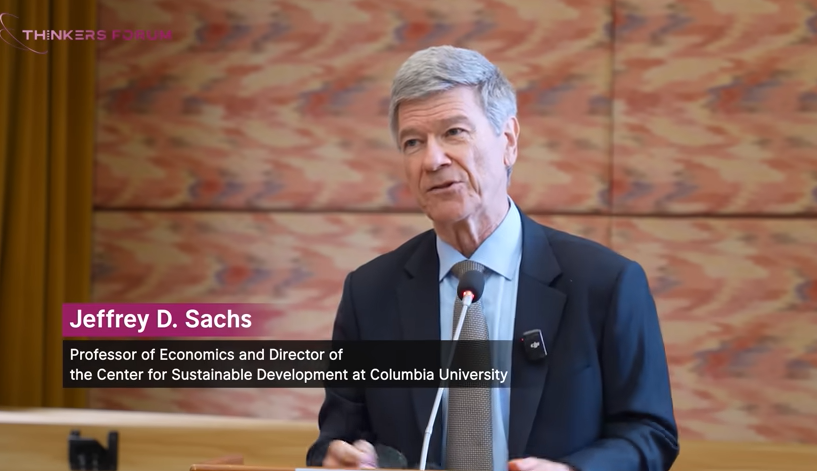
Renowned American economist Professor Jeffrey Sachs has issued a provocative assessment of the global economic landscape, asserting that the era of Western dominance officially concluded roughly 25 years ago. Speaking on the historical trajectory of global output, Sachs highlighted that Asia has successfully reclaimed the economic standing it held prior to the Industrial Revolution. While Asia’s share of world output plummeted from 60% in 1820 to just 18% by 1950 under the weight of Western imperial control, the post-independence era has seen a dramatic reversal. By 2025, Asia’s economic share has surged back to over 50% of global output, with China emerging as the primary engine of this growth. Sachs emphasized that China has already surpassed the United States as the world’s largest economy in purchasing power parity terms—standing approximately 30% larger—and has achieved parity or leadership in the majority of industrial technology sectors.#
Looking toward the future, Sachs identified Africa as the next major pillar of global economic transformation. With Africa’s population projected to reach 3.7 billion by 2100—six times that of China—he argues that a close partnership between a resource-rich Africa and a technology-rich China represents a “win-win” scenario for the 21st century. Under this trajectory, Africa is forecasted to command 30% of world output by the century’s end. This shift is underpinned by six essential transformations: education and technological know-how, healthcare, sustainable industry, food security, sustainable urban development, and the digital economy.
Sachs was pointedly critical of the current American political mindset, particularly during the Trump administration, characterizing it as an outdated attempt to dictate global terms that no longer exist. He argued that the U.S. no longer holds a global economic or technological chokehold and suggested that domestic failures to redistribute economic gains are a self-inflicted political wound rather than a result of foreign competition. Ultimately, Sachs warned that the greatest threat to human progress is the risk of conflict in a nuclear age. He praised China’s decades-long avoidance of war and contrasted it with the United States’ persistent involvement in military conflicts, calling for a global shift toward cooperation over confrontation.