

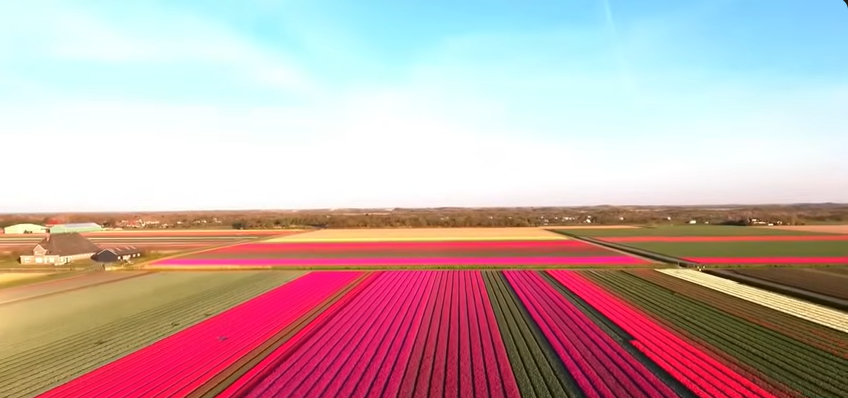
The Netherlands, despite its small size and challenging geographical conditions, has become a global agricultural powerhouse by embracing high-tech agriculture and modern large-scale farming. The country has turned its limitations into strengths, building an agricultural system that is admired worldwide for its efficiency, sustainability, and profitability. At the heart of this success is innovation in seed technology, where Dutch scientists engineer seeds for smart greenhouses that are disease-resistant and optimized for nutrient absorption, making crops resilient without chemical plant protection. This is complemented by soilless cultivation using Rockwool growing media, which replaces soil with a sterile, chemically inert environment that allows precise nutrient control while saving significant amounts of water and fertilizer. The Netherlands also dominates tulip farming, producing over 2.5 billion bulbs annually for global export. Farmers remove flowers at peak bloom to redirect nutrients to the bulb, ensuring large, high-quality bulbs that sustain the country’s reputation as the world’s largest tulip producer.
Dairy farming in the Netherlands is equally advanced, achieving record-breaking productivity through IoT networks that monitor cow health and automated systems such as the Ley Vector robot for precise feed distribution, the Ley Juno for feed pushing, and the Ley Astronaut robot for voluntary milking. These technologies optimize feed intake, reduce waste, and minimize stress on cows, setting new standards for animal welfare and efficiency. High-tech greenhouses further illustrate Dutch ingenuity, with tempered glass structures powered by combined heat and power systems. Natural gas generates electricity for LED lighting, while waste heat is recycled for heating, and industrial CO₂ is piped in as fertilizer through a national network, accelerating plant growth and increasing yields. Tomatoes, for example, are harvested continuously for up to eleven months, contributing significantly to the country’s agricultural export value.
The video then shifts focus to Australia, another agricultural giant thriving despite its arid conditions. Australia has built its success on scale and specialization, becoming the world’s second-largest beef exporter through vast cattle stations, heat-tolerant breeds, satellite monitoring, and helicopter-assisted management. This results in lean, omega-3 rich beef that is highly valued globally. Sheep farming is another cornerstone, with Australia producing merino wool that is prized for its sustainability and use in high-end textiles. Mechanized production drives the country’s “million-dollar fields,” covering almonds, wine grapes, and cotton. Almonds benefit from counter-seasonal harvesting, wine grapes are harvested with modern machines to ensure consistent quality, and cotton is processed efficiently through mobile operating complexes. Wheat production also thrives despite low rainfall, thanks to specially bred varieties with deep root systems and natural drying in the field, while GPS-equipped harvesters classify wheat quality in real time.
Agricultural machinery and poultry farming round out the story of modern farming excellence. Advanced machinery includes seeding drones for precise planting, spraying drones for crop protection, intelligent weeding systems like the InRow Weeder that eliminate herbicides, and rotary rakes for efficient hay gathering. Poultry farming, particularly in Australia, has shifted towards free-range production that emphasizes animal welfare. Mobile chicken coops reduce parasites and improve soil health, while automated egg processing plants handle cleaning, candling, grading, and packaging. Free-range chickens, constantly active, produce firmer meat that is increasingly sought after in global markets.

Together, the Netherlands and Australia demonstrate how technology, innovation, and scale can transform agriculture into billion-dollar industries. Their success stories highlight the importance of combining sustainability with efficiency, offering valuable lessons for countries seeking to modernize farming, maximize export potential, and secure their place in the global agricultural economy.